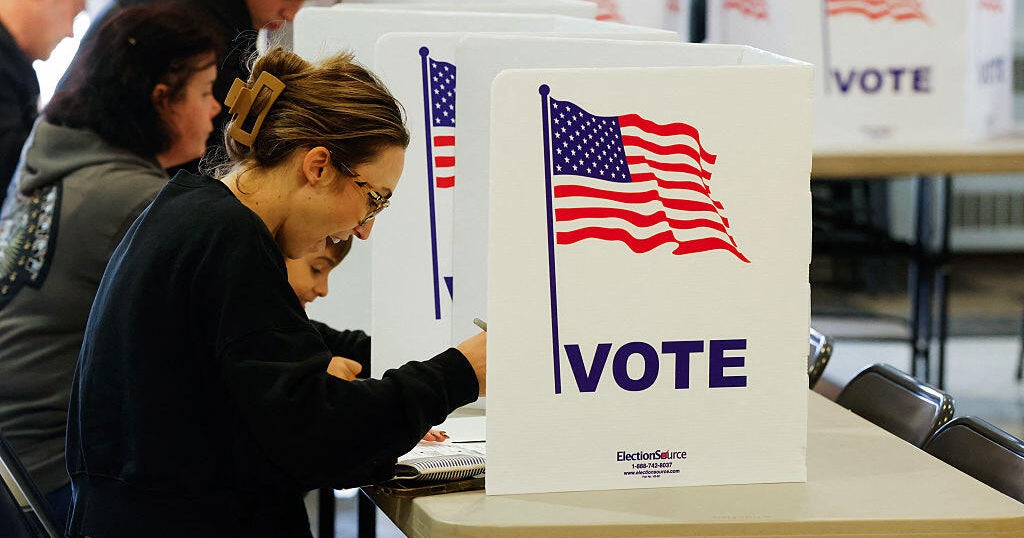
Americans went to the polls Tuesday to decide which party controls the House and Senate, with CBS News and other outlets carrying live coverage of the voting. The same day, federal charging documents unsealed in Oklahoma accused a man of mailing hundreds of envelopes containing white powder to public officials and news organizations in the run-up to both the 2024 and 2026 elections.
The defendant, Robin Patrick Martin, is alleged to have sent more than 700 letters to officeholders from both parties around the country, according to the documents. Authorities said the powder was not toxic and that the envelopes carried messages written in ink that reacts to ultraviolet light, making the text hard to read under ordinary conditions.
Martin faces one count of conveying false or misleading information and hoaxes and a second count of mailing threatening communications. It was not immediately clear whether he had been taken into custody.
An FBI affidavit quoted in the reporting says Martin raised what he saw as problems with the 2020 election, asserted that President Donald Trump won that contest, and expressed worry that some of the same concerns would resurface in the 2024 race.
Why it matters
The charges landed on the same day voters were deciding control of Congress, a contest widely framed as a referendum on Trump's second term. The case also points to a broader pattern: election workers and public officials have faced repeated threats and hoaxes in recent cycles, and mail-based scares force costly security responses even when the material turns out to be harmless.
Voting proceeds amid scattered problems
In Michigan, Republican Senate nominee Mike Rogers voted Tuesday morning and said he felt "really good about where we are today," according to CBS News. Rogers is running against Democrat Abdul El-Sayed. Over the weekend Rogers picked up an endorsement from Democrat Haley Stevens, whom El-Sayed narrowly beat in the primary; Rogers said Tuesday that Stevens "ought to celebrate her courage" and claimed other Democrats also consider El-Sayed too "extreme."
Fulton County, Georgia, reported two separate ballot-machine problems touching two polling places and roughly 1,000 early-voting ballots. One site dealt with repeated paper jams, while another had a power issue that raised worries about corrupted data.
The county first said it would ask its election board to formally approve modified counting procedures that evening, then said in an updated statement that it would seek permission to rescan the affected ballots in public. Officials proposed either moving machine memory cards or running the paper ballots through a central scanner. The board was set to take up the matter at a 6:30 p.m. meeting, with counting expected between 7 and 7:30 p.m. if approved. Georgia Secretary of State Brad Raffensperger said he did not expect the issues to hold up results.
In Iowa, Democrat Josh Turek voted in Council Bluffs and told CBS News he felt "great," comparing his confidence to the feeling he had in basketball and saying it came from preparation over 450 days of campaigning. Turek is running against Republican Rep. Ashley Hinson for the Senate seat Joni Ernst is leaving. He described the race as a "real clear choice" and has spent the campaign trying to link Hinson to corruption, arguing she grew wealthy while in office. Hinson has said she does not trade stocks and has denied Turek's claim that her husband works as a "shadow lobbyist." PolitiFact has reported that her wealth stems from her husband Matt Arenholz's stake in Highstreet Insurance Partners, which he received after selling his insurance agency to the private-equity-backed firm. Turek said too many Iowans are "hurting and struggling," pledged to work across party lines, and said he voted for some Republicans on Tuesday. He said he would keep campaigning until polls closed, noting he is "a little superstitious" after winning a statehouse seat by six votes.
Closing arguments and early turnout
House Speaker Mike Johnson spent the final day of the campaign telling voters the "polls are wrong." At a rally in Virginia's 2nd Congressional District with former Gov. Glenn Youngkin, campaigning for Rep. Jen Kiggans, Johnson said the mood reminded him of 2024, when Republicans won the White House and both chambers. "We are going to shock the world," he said, predicting House control would hinge on about 21 seats and warning that "it's going to be thin margins." He noted that Republicans won 10 races in 2024 by 6,000 votes or fewer.
Minnesota's secretary of state reported 886,427 early ballots cast through Sunday, the most ever for a midterm in the state and well above the 687,062 record set in 2022. Minneapolis alone had nearly 69,000 early voters, setting its own non-presidential-year record after accepting 52,661 early and absentee ballots as of Oct. 28, CBS News Minnesota reported.
Results in the closest House and Senate races, along with the Fulton County recount of affected ballots, are the numbers to watch as the night develops.